Friday, February 17, 2012

PIFF 35 Preview: THE TURIN HORSE


And here I thought I was going to be clever by comparing Béla Tarr's latest masterwork, The Turin Horse, to the 1993 Bill Murray vehicle, Groundhog Day.  All it took was a quick Google search to dispel any notion that mine was an isolated observation.  The comparison does hold quite well, though, as Tarr's picture places its characters, Ohlsdorfer (János Derzsi) and his daughter (Erika Bók) into a framework built upon daily repetition; one bleak, thankless task after the next, lather, rinse and repeat.


Where the two films diverge, however, is in intent; Tarr's story seems focused on the social plight of those made to subsist on little food and only meager shelter, while unnamed others have "acquired everything in a sneaky, underhanded fight."  The unending storm raging outside Ohlsdorfer's cottage, paired with the repetition across the film's documentation of six days, traps the characters in this world, allowing for few options other than those that preserve them in a state barely resembling life.


The Turin Horse is some kind of horror show; one where base reality becomes the stuff of nightmares, a slow, creeping apocalyptic vision that indicts the day-to-day, hand-to-mouth existence of the majority.  Tarr's affinities lie with Ohlsdorfer, his daughter and the titular beast, whose own degraded state is reflective of the people in the film.  Those not suffering under such conditions are kept out of view, hidden by the storm and ignored by the film, save a brief mention of having "debased everything."

This is reportedly Tarr's final work as a director.  If this holds true, it's one hell of a way to end his career.  Tarr and his regular crew of collaborators have crafted a slow-moving, elegiac farewell of such depth and substance that one wonders if they ever could have topped it.


The Turin Horse will screen for the public at Cinema 21 on Feb. 18th at 8:15pm and Feb. 21st at 7pm.

Remember to find and "like" us on our Facebook page.
Subscribe to the blog's feed here.

Thursday, February 16, 2012

PIFF 35 Preview: ONCE UPON A TIME IN ANATOLIA


Darkness enshrouds the landscape in much of Nuri Bilge Ceylan's (Climates, Distant) latest work, Once Upon a Time in Anatolia; the best film I've seen from this year's crop at the Portland International Film Festival.  Whereas some films at the fest have seemed wafer thin (The Silver Cliff being a prime example), Ceylan's is a substantial feast; a visually stunning, 2 1/2 hour-long flick that navigates its extended running time without losing the interest of viewers or relying on cheap spectacle to keep 'em in their seats.  The balance is all in the story and characters, both of which are, like the land traversed, hidden from full view at first.


At the beginning of this tale, all we know is that a caravan of cars are driving at night.  They carry a group that includes a police commissar (Yilmaz Erdogan) and his men, a prosecuting attorney (Taner Birsel), a doctor (Muhammet Uzuner) and some suspects.  One of the suspects, Kenan (Firat Tanis), is leading them to where a body has been buried.  The only problem is that Kenan had been drinking heavily when the suspects disposed of their victim, so he's having a difficult time remembering the exact spot.  Frustration sets in; an emotion that is transferred to the viewer, given the immersive quality lent to the film by its languid pacing and, eventually, the men begin to tell each other stories.


Ceylan pulls off a clever narrative bait-and-switch here: we expect the film to be about the search. But as the characters divulge their secrets one by one, it becomes clear that the film isn't in any hurry to resolve that quest.  So we're left with what the men have to say to each other and the golden-hued spaces in which they speak their truths; a far more fascinating prospect than I could describe here without spoiling the content of those conversations.


I've enjoyed other films by Ceylan, especially Climates, but Once Upon a Time in Anatolia feels to me like the moment in which a good director has transformed into a great one.  This belongs on every cinéaste's queue.  Don't wait for video; the film deserves to be seen on the big screen.


Once Upon a Time in Anatolia will screen for the public at Cinema 21 on Feb. 19th at 7:30pm and Feb. 24th at 3pm.

Remember to find and "like" us on our Facebook page.
Subscribe to the blog's feed here.

Wednesday, February 15, 2012

PIFF 35 Preview: SNOWTOWN


In the overall realm of indie drama, there's the gritty stuff and then there's Snowtown, an Australian feature that makes darkly-themed masterpieces like Michael Cuesta's L.I.E. and Andrea Arnold's Fish Tank seem almost lighthearted in comparison.  First time director Justin Kurzel shows an unflinching resolve to tell his story without compromises; a choice that means that many people will not make it all the way to the end of his debut film.  For what it's worth, it's an incredibly well-crafted but, ultimately, bleak and disturbing picture.


Let's quickly go over the details: Jamie (Lucas Pittaway) lives with his mother, Elizabeth (Louise Harris), and his brothers in a run down hovel.  Not long after Elizabeth unwisely leaves her boys in the care of a neighborhood pedophile, she begins a relationship with John (Daniel Henshall), whose unhealthy obsession with retribution against sex offenders is an early indicator of his own violent dysfunction.  John and Jamie rapidly hit a dynamic that mimics a father-son relationship, promising Jamie a respite from his otherwise bleak existence, that is, until John places a gun in his hand, demanding that he become an accomplice in the first of many unthinkable tasks.


Snowtown is based on the true story of John Bunting, a notorious Australian serial killer, whose extreme hatred for homosexuals and pedophiles led him to perpetrate a series of crimes known as the Snowtown murders.  Although it's focused on Bunting's crimes, the story is relayed almost entirely from Jamie's perspective, which means the viewer is given just the contours of Bunting's malevolence at first, providing a Hitchcockian tension to the film that, once the threat has been fully substantiated, fills the audience with fearful apprehension about what lies ahead.

It's also worth noting the overall aesthetic at play here.  I mentioned Fish Tank at the beginning of the review.  Like that film, Snowtown draws heavily from Ken Loach's strategies for social realist storytelling, handheld camerawork mingles with an undressed sense of poverty-stricken places and the disenfranchised people who occupy them.

Because Kurzel's film is about a serial killer, the overall result of the realist approach couldn't be farther from other movies dealing with the same phenomenon; unlike Hollywood blockbusters about serial killers, this film doesn't romanticize or glorify its monster.  Contrasted with examples of the genre like American Psycho or Natural Born Killers, Snowtown is truly capable of inspiring a horrified recoil in the viewer, especially in those willing to stick with it and ponder the unmitigated evil being depicted here.


It's an incredibly potent and self-assured debut film, exceptionally nihilistic in its worldview and containing hypnotic, career-making performances from both Pittaway and Henshall.  It's also one of the darkest films I've ever seen at a festival, presenting sequences involving incest, pedophilia, torture, murder, animal abuse, etc.  Consider yourself warned.


Snowtown will screen for the public at the Lloyd Mall 6 on Feb. 24th at 6:30pm and at the Whitsell Auditorium on Feb. 25th at 8:30pm. 

Remember to find and "like" us on our Facebook page.
Subscribe to the blog's feed here.

Monday, February 13, 2012

PIFF 35 Preview: FREE MEN


There's a good chance that many people will come to Free Men because Tahar Rahim is its lead actor.  Fair enough, Rahim deservedly got a lot of attention for his electrifying performance in Jacques Audiard's 2009 prison crime film, A Prophet.  I hadn't read anything about Free Men before seeing it, so I wasn't even aware in advance that Rahim is in the film.  To his credit, he disappears so much into the role of Younes, a black market smuggler turned resistance fighter, that I didn't recognize him until the final scene of the film.


The movie that Rahim appears in is only slightly less nuanced than his performance, probably due to a lower budget than what Audiard's film was afforded.  Free Men is set in Paris during the Nazi occupation, focusing on Algerian men who threw their lot in against the occupying forces.  The main thrust of the story lies with Younes burgeoning friendship with Salim (Mahmud Shalaby), an Algerian singer whose true ethnicity is called into question by German forces.  Seeing the danger that is unfolding, Younes is forced to interrogate the ethical code upon which he has always relied, choosing between self-preservation or what he knows to be the right path.


Free Men contains a very good third act, but does take its time getting there.  There's a strong sense of economy at play in the film that, while delaying the thrills early on, saves the majority of the impact for when its best utilized, near the end of the story.


Free Men screens twice more for the public at Cinemagic on Feb. 14th at 6pm and at the Lloyd Mall 6 on Feb. 20th at 2:30pm. 

Remember to find and "like" us on our Facebook page.
Subscribe to the blog's feed here.

Saturday, February 11, 2012

PIFF 35 Preview: PATAGONIA


Patagonia does something that's become quite common in contemporary cinema; it attempts to tell parallel stories based around a single theme.  Like with Robert Altman's Nashville, pretty much the model for how this structure works, director Marc Evans (Snow Cake) chooses to make the setting of his film the lead character; in this case, the South American region referenced in the title.

As an audience, we're allowed to watch as two separate couples travel the land; one a romantic pairing (Nia Roberts and Matthew Gravelle) that drifts apart as the story develops, another a young man, Alejandro (Nahuel Pérez Biscayart) tricked into voyaging to Patagonia with his elderly neighbor, Cerys (Marta Lubos).  


The latter tale is the more interesting of the two and I couldn't help wishing that Evans had chosen to focus only on Alejandro and Cerys' journey.  The other story arc comes off as overly soapy in a film where the tone doesn't justify the dramatic excesses of the material, resulting in a film that feels more than a little schizophrenic at times.  Even though you can easily guess how Alejandro and Cerys' story will end, it's lovely to watch as the two meander through Patagonia, searching for the farm where Cerys' mother used to live.


Patagonia will screen for the public at the Lake Twin Cinema today (Feb. 11th) at 8:30pm and at Pioneer Place 5 on Feb. 14th at 8:45pm  A final screening will occur on Feb. 16th at Cinemagic at 6pm.

Remember to find and "like" us on our Facebook page.
Subscribe to the blog's feed here.


PIFF 35 Preview: MONSIUER LAZHAR


Philippe Faladeau's Monsieur Lazhar travels well-trodden cinematic ground; it's easily filed into the inspirational teacher genre, of which there are already some fairly successful models out there (To Sir, with Love and Stand and Deliver come to mind).  So it's nice to see that what could have been yet another by-the-numbers entry is, in fact, an intelligent and humanistic look at a group of students and the adults mentoring them through the healing process in the wake of a tragic event.


Bachir Lazhar (Mohamed Fellag) is a man who has recently immigrated to Quebec from his Algerian homeland.  He shows up at the elementary school where most of the action of the film takes place, seeking to replace a teacher who has recently died.  While the circumstances behind Bachir's move are complicated, they make him the ideal candidate for dealing with a classroom packed full of children who have recently experienced their own loss.


While Fellag is wonderful in the film, exuding both deep sorrow and empathy, often in the same moment, the children's performances are amazingly nuanced as well.  This is especially true of the work of Sophie Nélisse and Émilien Néron, both of whom fearlessly project a complexity beyond their years.

Monsiuer Lazhar is an excellent film with an emotional core that has the potential to resonate for all ages (however, younger children might have difficulty with the themes or the fact that the film is subtitled).  In many ways, it reminded me of Thomas McCarthy's The Visitor, another film that tackles difficult subject matter in an optimistic fashion without attempting to declaw the more troubling emotional aspects at play.


Monsiuer Lazhar will screen for the public at the Lake Twin Cinema today (Feb. 11th) at 3pm and at the Lloyd Mall 6 on Feb. 13th at 6:15pm  A final screening will occur on Feb. 15th at Pioneer Place 5 at 8:45pm.

Remember to find and "like" us on our Facebook page.
Subscribe to the blog's feed here.


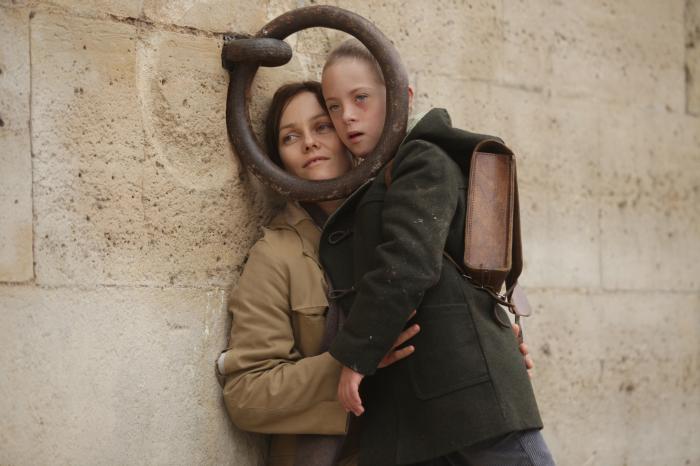
PIFF 35 Preview: CAFÉ DE FLORE


When writing during PIFF 34 about Le Quattro Volte (The Four Times), I noted that every year there's at least one film at the festival that seems to come out of nowhere, surprising me to no end and causing me to wonder how it escaped being caught up in the festival-circuit hype machine.  This year, Café de Flore is that film.

Directed by Jean-Marc Vallée (C.R.A.Z.Y., The Young Victoria), this French-Canadian import had me aware that I was watching a truly great film in the first fifteen minutes, something that always makes me nervous, worrying about the path that the rest of film will take, hoping that the delicate balance struck by the filmmakers doesn't dissipate before the end credits crawl across the screen.


Café de Flore did not disappoint.  Vallée is unapologetic in his attempts to wow the audience with the sheer audacity of how he intends to tell the story.  His technique is an invigorating mixture that pulls from familiar scenarios; a man who regrets where his choices have led him, while pushing the tale with a structure that offers unique thrills throughout.

At the beginning of the film, we're introduced to three characters: Antoine (Kevin Parent), Jacqueline (Vanessa Paradis) and Carole (Hélène Florent).  Thanks to the fact that dreams are heavily involved in the story; one of the three characters is a somnambulist, it's initially unclear if all of the characters are real, due to the disruptive nature of the quick shifts between sleeping and waking states and Vallée's clever use of differing color palettes.  This ambiguity, coursing through the whole of the picture, heightens the storytelling beyond the base realities of the lives portrayed.  The result is a film that dares the audience to care; a drama with all the dressings of a tense thriller.


I'll be very surprised if I am still not raving about Café de Flore at the end of the year.  So far, I've seen twenty-four of the features programmed for this year's festival.  Of that number, Café de Flore easily rests in the top three overall.


Café de Flore will screen for the public at the Lake Twin Cinema on Feb. 11th at 5:30pm and at the Lloyd Mall 5 on Feb. 13th at 6pm  A final screening will occur on Feb. 20th at the Cinema 21 at 7:30pm.

Remember to find and "like" us on our Facebook page.
Subscribe to the blog's feed here.

submit to reddit