If there's any justice in this world, Bullhead will take home the trophy for best foreign language film next Sunday (although I suspect a much safer film will do so). Either way, go see this movie! Hit the link to see what I had to say about it a couple of weeks ago.
Remember to find and "like" us on our Facebook page. Subscribe to the blog's feed here.
It didn't matter how tired I was after so many PIFF screenings. There was no way I was gonna miss out on Wim Wenders' appearance at Cinema 21 last week. The man is a personal hero of mine, his fluidity of process continually inspiring my own approach to creative work.
There's a unique flavor of narrative freedom saturated with resigned nostalgia present in the best of Wenders' work (Alice in the Cities, Lightning Over Water, Paris, Texas, and The American Friend, to name just a few). Even if you've only seen a couple of his movies, his style is unmistakable, though his path to getting there varies from project to project.
One of the New German Cinema pack (a name given by film journalists to a group of post-reconstruction era German auteurs of the time that also included Werner Herzog, Rainer Werner Fassbinder, Hans-Jürgen Syberberg, etc.) that sprung into the limelight during the 1970s, Wenders, like Herzog,
is one of the few who grew into an international artist, working outside
of Germany regularly, spreading his European sensibilities beyond the borders of his homeland.
Presently, he's promoting his most recent film, Pina, the Oscar-nominated, 3D documentary that presents the work of the late choreographer/dance company director Pina Bausch. It's why he showed up in our small burg, introducing the film, as well as sticking around to answer a few questions from the audience after the 7pm screening.
Before the film, Wenders asked if anyone had ever been to a small village named Wuppertal, where the film is set. A couple of hoots from the audience either suggested that, yes, a few people had visited, or that the many beers being sold in the lobby were inspiring an agreeable conviviality bordering on benign deception; either way, it was clear that the audience was already in the palm of Wim's hand.
The film itself is a wonderful use of stereoscopic technology. Even more than Herzog's Cave of Forgotten Dreams, I can't imagine how reduced the experience would be by seeing the film in a two-dimensional presentation. It requires the illusion of defined 3D space to properly convey the dances that Pina and her company conceived together. Beyond that, it's a beautiful introduction to Pina's work, even to a dance neophyte such as myself.
Post-screening, Wim admitted that if Pina had not passed shortly before
shooting on the project began the film would have been an
entirely different picture. He said his original vision was to make a film about Pina's eyes, the way she saw, and how it influenced her work. After Bausch's death, the dancers convinced Wenders that there was still a film that could be made about Pina; one that still included the four numbers that Pina had wanted in the project.
On their own, those dance pieces were not enough to constitute a film and Wenders found himself in need of an appropriate solution for supplementing the material. He relied on the dance company's intimate knowledge of Pina's process to inform his own ability to add to the planned material, devising a film that included additional dances prompted by a complex series of (Pina's) questions answered by danced responses. Those additions, all filmed outside the studio, add a harmonizing playfulness that breathes much life into the film. Yet again, another example of Wenders' ability to work outside the box to great results.
If you'd like to hear Wenders speak more about the project, why not listen to the most recent edition of the NW Film Center's Adjust Your Tracking podcast, featuring Film Center staffer/journalist Erik McClanahan's phone conversation with him. Hit the link to tune in.
All photos are courtesy of Viva Las Vegas, who was lucky enough to be in the front row for Wenders' Q&A. Thanks again, Viva!
Also many thanks to both Cinema 21 and PIFF/NW Film Center for partnering to bring Wenders to PDX! A great night, folks.
Remember to find and "like" us on our Facebook page. Subscribe to the blog's feed here.
And here I thought I was going to be clever by comparing Béla Tarr's latest masterwork, The Turin Horse, to the 1993 Bill Murray vehicle, Groundhog Day. All it took was a quick Google search to dispel any notion that mine was an isolated observation. The comparison does hold quite well, though, as Tarr's picture places its characters, Ohlsdorfer (János Derzsi) and his daughter (Erika Bók) into a framework built upon daily repetition; one bleak, thankless task after the next, lather, rinse and repeat.
Where the two films diverge, however, is in intent; Tarr's story seems
focused on the social plight of those made to subsist on little food and only meager shelter, while unnamed
others have "acquired everything in a sneaky, underhanded fight." The unending storm raging outside Ohlsdorfer's cottage, paired with the repetition across the film's documentation of six days, traps the characters in this world, allowing for few options other than those that preserve them in a state barely resembling life.
The Turin Horse is some kind of horror show; one where base reality becomes the stuff of nightmares, a slow, creeping apocalyptic vision that indicts the day-to-day, hand-to-mouth existence of the majority. Tarr's affinities lie with Ohlsdorfer, his daughter and the titular
beast, whose own degraded state is reflective of the people in the film. Those not suffering under such conditions are kept out of view, hidden by the storm and ignored by the film, save a brief mention of having "debased everything."
This is reportedly Tarr's final work as a director. If this holds true, it's one hell of a way to end his career. Tarr and his regular crew of collaborators have crafted a slow-moving, elegiac farewell of such depth and substance that one wonders if they ever could have topped it.
The Turin Horse will
screen for
the public at Cinema 21 on Feb. 18th at 8:15pm and Feb. 21st at 7pm.
Remember to find and "like" us on our Facebook page. Subscribe to the blog's feed here.
There's a good chance that many people will come to Free Men because Tahar Rahim is its lead actor. Fair enough, Rahim deservedly got a lot of attention for his electrifying performance in Jacques Audiard's 2009 prison crime film, A Prophet. I hadn't read anything about Free Men before seeing it, so I wasn't even aware in advance that Rahim is in the film. To his credit, he disappears so much into the role of Younes, a black market smuggler turned resistance fighter, that I didn't recognize him until the final scene of the film.
The movie that Rahim appears in is only slightly less nuanced than his performance, probably due to a lower budget than what Audiard's film was afforded. Free Men is set in Paris during the Nazi occupation, focusing on Algerian men who threw their lot in against the occupying forces. The main thrust of the story lies with Younes burgeoning friendship with Salim (Mahmud Shalaby), an Algerian singer whose true ethnicity is called into question by German forces. Seeing the danger that is unfolding, Younes is forced to interrogate the ethical code upon which he has always relied, choosing between self-preservation or what he knows to be the right path.
Free Men contains a very good third act, but does take its time getting there. There's a strong sense of economy at play in the film that, while delaying the thrills early on, saves the majority of the impact for when its best utilized, near the end of the story.
Free Men screens twice more for
the public at Cinemagic on Feb. 14th at 6pm and at the Lloyd
Mall 6 on Feb. 20th at 2:30pm.
Remember to find and "like" us on our Facebook page. Subscribe to the blog's feed here.
Patagonia does something that's become quite common in contemporary cinema; it attempts to tell parallel stories based around a single theme. Like with Robert Altman'sNashville, pretty much the model for how this structure works, director Marc Evans (Snow Cake) chooses to make the setting of his film the lead character; in this case, the South American region referenced in the title.
As an audience, we're allowed to watch as two separate couples travel the land; one a romantic pairing (Nia Roberts and Matthew Gravelle) that drifts apart as the story develops, another a young man, Alejandro (Nahuel Pérez Biscayart) tricked into voyaging to Patagonia with his elderly neighbor, Cerys (Marta Lubos).
The latter tale is the more interesting of the two and I couldn't help wishing that Evans had chosen to focus only on Alejandro and Cerys' journey. The other story arc
comes off as overly soapy in a film where the tone doesn't justify the
dramatic excesses of the material, resulting in a film that feels more
than a little schizophrenic at times. Even though you can easily guess how
Alejandro and Cerys' story will end, it's lovely to watch as the two meander through Patagonia, searching for the farm where Cerys' mother used to live.
Patagonia will
screen for
the public at the Lake Twin Cinema today (Feb. 11th) at 8:30pm and at Pioneer Place 5 on Feb. 14th at 8:45pm A final screening will occur
on Feb. 16th at Cinemagic at 6pm.
Remember to find and "like" us on our Facebook page. Subscribe to the blog's feed here.
When writing during PIFF 34 about Le Quattro Volte (The Four Times), I noted that every year there's at least one film at the festival that seems to come out of nowhere, surprising me to no end and causing me to wonder how it escaped being caught up in the festival-circuit hype machine. This year, Café de Flore is that film.
Directed by Jean-Marc Vallée (C.R.A.Z.Y., The Young Victoria), this French-Canadian import had me aware that I was watching a truly great film in the first fifteen minutes, something that always makes me nervous, worrying about the path that the rest of film will take, hoping that the delicate balance struck by the filmmakers doesn't dissipate before the end credits crawl across the screen.
Café de Flore did not disappoint. Vallée is unapologetic in his attempts to wow the audience with the sheer audacity of how he intends to tell the story. His technique is an invigorating mixture that pulls from familiar scenarios; a man who regrets where his choices have led him, while pushing the tale with a structure that offers unique thrills throughout.
At the beginning of the film, we're introduced to three characters: Antoine (Kevin Parent), Jacqueline (Vanessa Paradis) and Carole (Hélène Florent). Thanks to the fact that dreams are heavily involved in the story; one of the three characters is a somnambulist, it's initially unclear if all of the characters are real, due to the disruptive nature of the quick shifts between sleeping and waking states andVallée's clever use of differing color palettes. This ambiguity, coursing through the whole of the picture, heightens the storytelling beyond the base realities of the lives portrayed. The result is a film that dares the audience to care; a drama with all the dressings of a tense thriller.
I'll be very surprised if I am still not raving about Café de Flore at the end of the year. So far, I've seen twenty-four of the features programmed for this year's festival. Of that number, Café de Flore easily rests in the top three overall.
Café de Flore will
screen for
the public at the Lake Twin Cinema on Feb. 11th at 5:30pm and at the Lloyd
Mall 5 on Feb. 13th at 6pm A final screening will occur
on Feb. 20th at the Cinema 21 at 7:30pm.
Remember to find and "like" us on our Facebook page. Subscribe to the blog's feed here.
The organized crime genre is a pretty crowded fieldbut I'm fairly certain that Bullhead is the only film I've ever seen centered on the Flemish mafia. Directed by Michael R. Roskam, Bullhead doesn't romanticize it's characters or their trade; these mobsters deal in bovine growth hormone, forcing the local ranchers and farmers of the Belgian countryside to produce "their cows." The film begins just as a police investigator has been killed on the order of a crime boss.
If the crime angle is the wide view of the story, the close-in perspective lies with Jacky Vanmarsenille (Matthias Schoenaerts), a mountain of man whose own daily use of steroids and hormone treatment therapy darkly parallels the business in which he is an enforcer. Roskam slowly paints the details of Jacky's back story, showing us how a young child of promise was turned into a man who intimidates for a living.
Schoenaerts plays Jackie as a maladjusted child in a giant's body,
aching with loss, unable to connect with others, and placed into dire circumstances where he stands to lose everything.
This is a gritty, excellent character piece masquerading as a crime thriller. The majority of Belgian cinema I've encountered has been inspired either by the Dardenne brothers or the wry comedy of Finland's Aki Kaurismäki (Eldorado or Aaltra are examples of the latter's influence). In this regard, Bullhead feels fresh and without precedent in the realm of Belgian imports; its nearest comparisons in tone being Steve McQueen'sHunger or David Michôd'sAnimal Kingdom. It's a fascinating and disturbing ride, well worth the price of admission.
Bullhead will
screen for
the public at the Whitsell Auditorium on Feb. 11th at 12:30pm. A second screening is scheduled
on Feb.
14th at the Whitsell Auditorium at 8:45pm.
Remember to find and "like" us on our Facebook page. Subscribe to the blog's feed here.
The tensions of the Muslim/Christian divide in Lebanon are reproduced in miniature in actor-director Nadine Labaki's (Caramel) Where Do We Go Now?; a film set in a secluded, sleepy village where landmines and the daily news reports are constant reminders of the violent struggle raging elsewhere in the country. The twist of the piece rests in yet another division in the town, that of gender. Fearing that their men are being stimulated to mirror national displays of sectarian violence, the women take it upon themselves to manufacture distractions aimed at the men to keep the town from falling into chaos.
This leads to some very hilarious results, including the hiring of a group of seductively-dressed, Russian dancing women and a cooking scene involving the use of "special" ingredients. There's also a musical sequence, a dance routine, more than a little bit of tragedy and a love story peppered throughout the film. All this furious activity leaves Where Do We Go Now? feeling a little overstuffed with subplots, making me wish that the story had been more streamlined. As it stands, the film is a wee-bit schizophrenic in tone, shifting often between scenes infused with manic energy to moments drenched in sorrow.
Having said that, much of the film is quite enjoyable. It's just ends up feeling at times like a kitchen sink (not this kind of kitchen sink) approach to storytelling. Overly cluttered in parts, but a worthy diversion, nonetheless.
Where Do We Go Now? will
screen for
the public at the Whitsell Auditorium on Feb. 11th at 8:30pm and at the Lake Twin Cinema on Feb. 13th at 6pm and 8:30pm.
Remember to find and "like" us on our Facebook page. Subscribe to the blog's feed here.
Fans of absurdist humor shouldn't hesitate to rush out to one of the upcoming screenings of The Fairy, the newest comedy from the French acting/directing trio of Dominique Abel, Fiona Gordon and Bruno Romy (L'iceberg, Rumba). How to begin talking about this one? It's a film powered by it's own off-kilter logic, beginning with a woman (Gordon) walking into the lobby of a hotel, bluntly declaring herself a fairy and offering the desk clerk (Abel) three wishes. Odd as that sounds, the truly weird and wonderful thing about that moment (and the majority of what follows) is the wide-eyed acceptance by these characters of everything and anything that the story throws at them.
Take for instance, the romantic underwater dance scene that paves the way for a baby to enter the narrative. Any other film that might orchestrate as pleasurably surreal a sequence as this would likely have it spring from the dream state of one of its characters. Not at all the case in The Fairy. The scene, which comes off as some kind of hybridized love child of the classic output of Buster Keaton and the Fleischer brothers, is played completely straight, as if there is no distinction between the reality of the hotel and the undersea dance palace where Dom and Fiona boogie the night away.
I'd never seen anything by Abel, Gordon and Romy before catching The Fairy (something I've since remedied with a home viewing of L'iceberg). Their style strikes me as a fresh, revisionist take on farce that regularly slips into extremely amusing displays of whimsy.
There's really no one to whom I wouldn't recommend this film, unless there's someone out there with a grudge against laughter and fun. It's entirely fine for older kids, although it certainly isn't aimed at a children's audience. It isn't often that something with the potential to have such a wide demographic appeal plays the art house circuit (the last example I can think of is A Town Called Panic). Seriously, don't miss it, okay?
The Fairy will
screen for
the public at Lloyd Mall 6 on Feb. 10th at 8:45pm and Feb. 11th at 3:30pm A final screening will occur
on Feb.
14th at the Lake Twin Cinema at 8:30pm.
Remember to find and "like" us on our Facebook page. Subscribe to the blog's feed here.
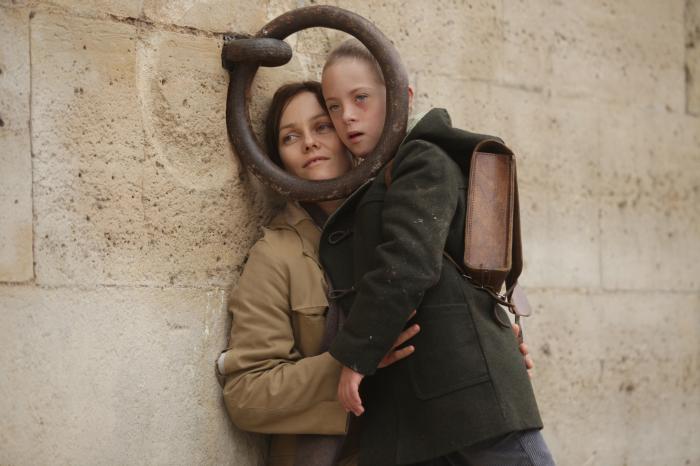
A large group of men huddle outdoors as their union representative, Michel (Jean-Pierre Darroussin) calls out names drawn from a box. He pulls his own name, thus joining the ranks of those laid off from working at the docks. His brother-in-law Raoul (Gérard Meylan) asks if Michel is "crazy" for including himself in the drawing, while Michel's wife, Marie-Claire (Ariane Ascaride) comments that it's hard sometimes to live with a "hero." These differing reactions describe the central tension of Robert Guédiguian'sThe Snows of Kilimanjaro, a meditation on how our values hold up when tested.
Essentially, it is Michel and Marie-Claire's faith in their own social status that is at stake in the film. Shortly after entering into early retirement, the couple is robbed at gunpoint by Christophe (Grégoire Leprince-Ringuet), one of the workers whose name Michel had pulled during the layoffs. When Christophe is apprehended by the police, Michel confronts the younger man about what he has done. Instead of showing remorse, Christophe shocks Michel by challenging the comforts he will enjoy as a middle class pensioner, contrasting the safety net afforded Michel with the complete lack of security the other laid off men have available to them.
Though the scene between Christophe and Michel is brief, the debate rages on throughout the film as Michel and Marie-Claire are treated to a variety of opinions on the matter from friends, family and the police. For their part, they seem more interested in direct action, coming to the aid of Christophe's young brothers, pausing only once to discuss the strain between the socialist views they've held and the class position they occupy.
It's a film anchored by the performances, especially the work of Darroussin, whose quiet expressiveness modulates masterfully between growing humiliation and graceful acceptance. Even when the plot veers towards becoming an apologist piece, his solid presence offers the viewer something to embrace.
The Snows of Kilimanjaro will
screen for
the public at Cinemagic on Feb. 11th at 6pm and at the Lloyd
Mall 6 on Feb. 13th at 8:45pm A final screening will occur
on Feb.
16th at the Lake Twin Cinema at 8:30pm.
Remember to find and "like" us on our Facebook page. Subscribe to the blog's feed here.
Roman Kolger (Thomas Schubert) has a problem. He's been in prison since the age of 14 and now, at age 19, needs to find work in order to gain parole. He's not terribly animated, motivated or skilled, so it seems awfully befitting when he falls into a job as an undertaker. Breathing (Atmen) is a slow-moving, Austrian character piece that hovers warily over its protagonist, rarely offering hope but, patiently, revealing small details and slight grace notes that allow for insight into Roman's plight.
At first, there is only one thing we know about Roman; he's alone in this world. The only advocate he has is a social worker who drives him around town, prepping him for an upcoming parole hearing. The film is predominantly built upon extended moments of observation that yield small reveals, most of which occur in the spare moments when Roman risks interaction with others. There is a fleeting encounter with a girl on the train back to his holding cell. A failed attempt to reach out to a co-worker. And another involving an older woman...but I don't want offer up too much, especially since this is a film that hinges so delicately on little details.
Austrian actor-turned-director Karl Markovics understands that explanations aren't of primary concern to his story. Instead, he sticks with small events and repeated passages, like the indignities that Roman must endure each night as he returns to prison, to draw in the viewer. It's a particularly strong directorial debut for Markovics, who has spent much of his prior career on television and in the theater. Likewise, Schubert's turn as Roman, his first film role, has an appropriately affectless feel to it. He plays Roman as someone who has been abandoned by society; a truth that only deepens as the evidence of his life unfolds.
Breathing (Atmen) will screen for
the public at the Lloyd Mall 6 on Feb. 10th at 6:15pm and, again, at Cinemagic on Feb. 12th at 8pm. A final screening will occur on Feb. 14th at the Lake Twin Cinema at 6pm.
Remember to find and "like" us on our Facebook page. Subscribe to the blog's feed here.
Early on in writer-actor-director Valérie Donzelli'sDeclaration of War, written in semi-autobiographical collaboration with her co-star Jérémie Elkaïm, a young man and woman (Romeo and Juliette) have a chance meeting at a noisy nightclub. After exchanging names, the woman states with some amusement, "so we're doomed to a terrible fate." Her tossed off prediction, it turns out, is both true and false.
The scene is a flashback directly following an establishing moment with Juliette standing over their son, Adam, as he's undergoing an MRI scan. His ailment, a brain tumor, is the prolonged concern of the film, which somehow is able to sustain an optimistic energy throughout, even with the plot centering on a parent's worst nightmare.
All credit for this result rests with the writing and performances; the entire film is grounded by the beautifully observed adult relationship that lies at the center of the film. Romeo and Juliette's strengths, weaknesses and overall growth in the face of the circumstances they face as parents are all made available to the viewer. Their love feels authentic and, even when the filmmakers take risks that don't entirely pay off; the awkward musical duet that plays out shortly after they find out about Adam's illness, for instance, watching the couple interact onscreen is a captivating and joyful experience. Strange as it sounds, I'd argue that the film is essentially a romance, albeit one that folds childhood cancer into the mix. Highly recommended.
Declaration of War will screen for
the public at the Whitsell Auditorium on Feb. 10th at 8:30p.m.
Remember to find and "like" us on our Facebook page. Subscribe to the blog's feed here.
The Salt of Life is writer-director Gianni Di Gregorio's second film, after the charming surprise that was Mid-August Lunch, to follow the modest exploits of an aging Italian man named Gianni (played by Di Gregorio, naturally). The first film had Gianni entertaining his elderly mother and her friends, cooking them elaborate meals while watching over them. This time around, Gianni's on his own and looking for a little romance, despite the fact that he's a family man.
Di Gregorio places Gianni into a context that makes the moral aspect of Gianni's quest harmless, allowing the audience to be amused by his missteps, rather than concentrate on the infidelity. We know early on that he's in a sexless marriage, broke, unemployed and endlessly called upon by his mother and others for errands and help. In these relationships, he exudes a selflessness bordering on the masochistic, never really taking anything for himself, always accepting what comes to him, no matter how thankless. So, when a friend keeps suggesting that Gianni seek a little pleasure for himself in the form of an affair, the logic of the world presented makes it seem a reasonable route, even if it takes a while for Gianni to come around to the idea.
The Salt of Life is the rare sequel that works, fully recapturing the magic that made Mid-August Lunch such a treat. It's completely unnecessary to have seen the former film in order to appreciate it, although a quick look at Mid-August Lunch (it's a breezy 80-min. in length) will only deepen your joy when watching the new movie.
In the screening that I saw, there were numerous moments that evoked roars of laughter from the audience. This is easily the funniest film I've seen in 2012, wringing humor out of even the most cliched of situations. It's a rare treat and I'll probably still be talking about it as the year comes to a close.
The Salt of Life will screen for
the public at the Lake Twin Cinema on Feb. 10th at 6pm and, again, at Cinemagic on Feb. 12th at 5:45pm.
Remember to find and "like" us on our Facebook page. Subscribe to the blog's feed here.
And here we go again: the press screenings for the 35th annual Portland International Film Festival began yesterday morning. First up, a film about young love or, really, recovery from first love.
Goodbye First Love is Mia Hansen-Løve's (Father of My Children) take on the puppy love, gone awry film. Young Camille (Lola Créton) is hopelessly taken with her boyfriend Sullivan (Sebastian Urzendowsky). Sullivan claims to love her but also doesn't want to grow "too dependent," spending nights away from Camille at parties while planning a move to South America. Predictably, it's not long before Sullivan is out of the picture, fracturing her immature view of what constitutes life.
The film spends an incredible amount of time focusing on Camille's emotional recovery, only to send her into the arms of her much older architectural studies professor, Lorenz (Magne-Håvard Brekke), a move that, like the initial breakup with Sullivan, one can see coming from a mile away. This relationship is also strained, although, this time, it's her inability to fully commit that threatens it.
Overall, Goodbye First Love is a perfectly fine distraction. It's well shot and the performances are admirable. If there is something to complain about, it's that Hansen-Løve focuses so intensely on Camille's post-breakup depression that there's little room for plot advancement during a very large chunk of the film. Most of the time, when it's not bogged down by pacing issues, it's a fairly pleasant, though somewhat slight, film.
Goodbye First Love will screen for the public at the Lloyd Mall 5 on Feb. 12th at 2pm and, again, at Cinema 21 on Feb. 17th at 8:45pm.
Remember to find and "like" us on our Facebook page. Subscribe to the blog's feed here.