Showing posts with label technicolor. Show all posts

Thursday, March 29, 2012

RED DESERT: ANTONIONI'S VISION OF A TERRIBLE, TECHNICOLOR REALITY


Illness abounds in Michelangelo Antonioni's 1964 masterpiece Red Desert, the director's first foray into (Techni)color filmmaking.  Antonioni regular Monica Vitti returns as Giuliana, a woman recently discharged from the hospital after an accident related to her flawed mental state.  But it's not just Giuliani who is ill; the entire backdrop that constitutes the world in Red Desert is an industrial nightmare, wheezing and coughing up various colors of smoke and haze, birthing an environment that mirrors our protagonist's cluttered and fragmented vision of a terrible reality.


Against this image of a ravaged landscape, Giuliana travels from place to place as if experiencing a vision, one where only she can see the natural being supplanted by the man-made.  Yes, there are signs that the environmental spaces depicted are objective: both her husband, Ugo (Carlo Chionetti), and his business associate, Corrado (Richard Harris, looking here at times like a young Marlon Brando), witness a monumental amount of built up exhaust being released from the factory that Ugo manages, while her young son, Valerio (Valerio Bartoleschi), asks why the smoke funneling out of the factory is yellow.

Giuliana's crisis, however, seems to derive from her inability to see these signs of the modern age as the progress that Corrado interprets them as being.  She may also be experiencing an existentially felt sense of responsibility for the wreckage she witnesses; after all, her husband supports their bourgeois lifestyles with his job at the plant.  No one else in the film seems at odds with their surroundings, while Giuliana struggles ceaselessly against them.


Much like in his 1975 film, The Passenger, Antonioni departs from the main narrative in the third act for a short tale relayed by one character to another.  In both films, the story is allegorical, aiding in the viewer's understanding of the exceedingly elliptical, primary storyline.  Giuliana tells her son of a girl who lives in isolation on an island that is quite the opposite of the polluted spaces seen in the rest of the film.  Paralleling Giuliani's predicament, the island girl stumbles upon an essential truth pertaining to her surroundings. 


A helpful bit of context when viewing the film:  Red Desert appeared within two years of the publication of Rachel Carson's Silent Spring, a text often credited with kick-starting the modern environmental movement.  Whether or not Antonioni's film was directly influenced by Carson's book, it's really difficult to talk about Red Desert without at least acknowledging the impact that the environmental movement has on one's understanding of the film.  It's possible to imagine Red Desert as a poetic lens through which to view the urgency of environmental concern or, conversely, a conceptual piece driven by the zeitgeist of the early-to-mid 60s environmental consciousness.


Red Desert plays at the NW Film Center's Whitsell Auditorium (in the Portland Art Museum) on Thurs., March 29th through Sun., April 1st at 7pm. 


Remember to find and "like" us on our Facebook page.
Subscribe to the blog's feed here. 

Friday, February 24, 2012

DOUBLE INDEMNITY & FRANKENSTEIN MUST BE DESTROYED: Free 35mm-centric double feature @Cinema 21


Like it or not, 35mm projection is a dying form. The rumors of its death have been coming for years now as the digital revolution has rapidly gained ground, at first on film and television production sets, then, more recently, as the majority of theaters nationwide have added (or, in many cases, transitioned entirely to) digital projection for exhibition purposes.

Late last year, the most disturbing news of all emerged for lovers of the format; some major studios no longer have an interest in supplying theaters with archival prints, showing preference for digital formats over traditional film.

Care for a more local example of this technological shift? One of the Regal Cinemas locations in Portland is abandoning 35mm exhibition forever this week; the last film (read: 35mm presentation) shown there will be a PIFF 35 screening.


But (with all this context building) I'm kind of spinning away from the event that I wanted to highlight:  next week, local gem Cinema 21 is hosting what they're calling "a celebration of over a hundred years of celluloid bliss, before it disappears."  What this translates to is a double-feature of Billy Wilder's 1944 noir classic Double Indemnity paired with Hammer Productions' 1969 technicolor horror flick Frankenstein Must Be Destroyed


Tom Ranieri and the gang over at Cinema 21 are offering up their 35mm-centric, double-feature for two nights only, Wednesday, February 29th and Thursday, March 1st. What's more, admission is on them! Yeah, that's right, a FREE, classically-minded double billing at one of the best theaters in town. Be sure to thank them at their very reasonably priced concession stand. Maybe I'll see you in line?


The FREE double feature of Double Indemnity (@7pm) and Frankenstein Must Be Destroyed (@9:15) runs next Wednesday (2/29) and Thursday (3/1) at Cinema 21.  Don't miss out! 


Remember to find and "like" us on our Facebook page.
Subscribe to the blog's feed here.

Thursday, April 7, 2011

LEAVE HER TO HEAVEN: limited 3-day engagement in PDX


Portland is in for a treat this weekend as The Hollywood Theatre begins a 3-day run of a newly-restored, 35mm print of Leave Her to Heaven.  For those not in the know, the 1945 feature is one of the more treasured weapons in a film noir buff's arsenal, often referenced as an example of a rococo-like decadence that crept into the genre as it matured.

For starters, Leon Shamroy's (The King and I, Cleopatra) Oscar-winning cinematography is captured in a full-blown, 3-strip Technicolor sheen that trades vibrant hues for the high-contrast, black and white polarity that had all but become the standard in noir cinema.  Additionally, Leave Her to Heaven doesn't strictly adhere to noir tropes, blending sizable doses of melodrama and courtroom spectacle into its overall mix, emerging as a distinctive mélange that fits well outside the cinematic norms of its day.


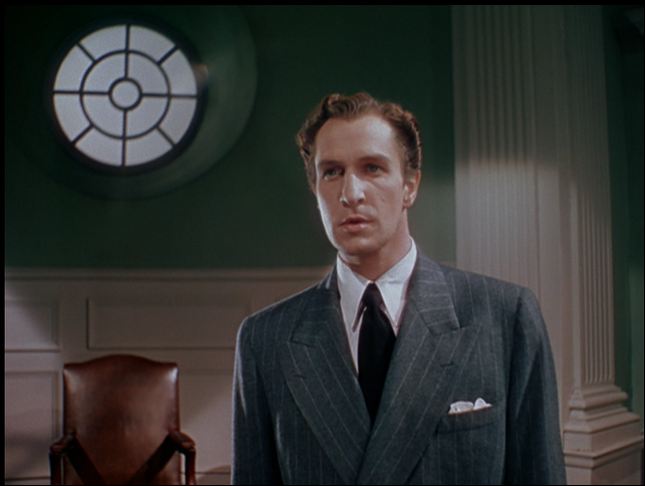
And the film is packed to the gills with more than enough memorable sequences to hang your enthusiasm upon, including one of the most harrowing examples of dramatized filicide ever committed to celluloid.  Ostensibly a vehicle for 1940s starlet Gene Tierney (Laura, Night and the City), Leave Her to Heaven also features a performance by Cornel Wilde that might come off as corny to some when placed against more modern sensibilities but, nonetheless, achieves a perfect balance between the chill that eventually blows into Tierney's characterization and the blustering heights that Vincent Price (The Fly, The Pit and the Pendulum) reaches for in the film.


And since we mentioned Mr. Price, it's worth noting just how much he does with what is essentially a supporting role in this movie.  The Vincent Price who appears in Leave Her to Heaven is an altogether different beast than the one that most contemporary audiences have come to expect.  This is Price before he became typecast as the voice of horror in a thousand and one b-grade productions, resulting in countless cultural references over the past half century that have unfairly painted him a one-trick pony.


Because of the dissimilarity to the most well-known aspects of his on-screen persona, Price's performance here, playing a spurned lover turned prosecuting attorney, is probably the most pleasurable to engage with on a first-time viewing.  To watch his final interrogation of Wilde's character is to witness the less than lawyer-ly techniques of television's "Perry Mason" (if you'll pardon the Spinal Tap reference) turned up to eleven.


Leave Her to Heaven screens at the Hollywood Theatre on Friday, April 8th at 7:15pm and Saturday, April 9th and Sunday April 10th at 2:30pm and 7:15pm.


Remember to find and "like" us on our Facebook page.
Subscribe to the blog's feed here.
submit to reddit