Showing posts with label experimental film. Show all posts

Sunday, September 22, 2013

CINEMA PROJECT TURNS 10, LOOKS BACK BEFORE MOVING FORWARD

Anyone who's glanced at this blog more than a few times knows that I have a big ol' soft spot in my heart for Cinema Project.  While they're not the only ones in town putting together incredible programs of experimental film (don't worry, EFF Portland, I love you, too), CP has kept their public exhibitions of outré cinema going for longer than most anyone would ever have expected possible.  You think it's difficult for indie and non-profit cinemas to turn a buck nowadays?  How's about a tight little crew of curators/film lovers without a permanent exhibition space and an exclusive focus on non-commercial works of art?  Needless to say, these folks are doing it for love, not money.


Which is why it's so fantastically inspiring that the organization is launching their 10th season this Saturday.  To celebrate their "tin" anniversary, CP is using their first screening of the fall to throw themselves a birthday party with a "best of" film presentation culled from the first 10 years of Cinema Project.


Here's what the good folks at the Project have to say about Saturday night's events:

Over the past ten years Cinema Project has organized and presented more than 100 unique film and video programs and only in rare instances do we ever show the same thing twice. The beginning of a ten-year anniversary, however, seems like a good time to break the rules and break into our own program archive. The first of two “best of” screenings (to be continued in Spring 2014), this program brings together a fun and unlikely mix of work that demonstrates the variety, breadth, and unique curatorial vision that Cinema Project is known for. Each past and present collective member has selected a favorite short film or video that he or she thinks deserves a second look, or that speaks anew to current political and cultural landscapes and personal outlooks. Older, newer, black-and-white, color, sound, silent, representational, abstract, psychedelic, poetic, diaristic, heavy, light: each is a skilled and personal production close to the artist who made it. This is the type of work we champion. 

At 10pm join us downstairs at the VFW Hall for a post-screening party and fall fundraiser kick-off, with DJs Cuica and Calle Danger, snacks, drinks, and sparkling conversation. Bring your dancing shoes!


Here's what's on tap for that evening:

Undefeated by Kevin Jerome Everson 
[US, 2008, video, b&w, sound, 1.5 min.] 

Associations by John Smith 
[US, 1975, 16mm, color, sound, 7 min.] 

 a-b-city by Brigitte Buhler and Dieter Hormel 
[West Germany, 1985, S8 transferred to video, color, sound, 8 min.] 

RE:THE_OPERATION by Paul Chan 
[US, 2002, Digital Video, color, sound, 26 min.] 

Nocturne by Phil Solomon 
[US, 1980/1989, 16mm, color, silent, 10 min.] 

Portrait, Tea Time, and Red Curtain by Helga Fanderl 
[Germany, 1992-2009, S8 blown up to 16mm, 18fps, color, silent, 7 min.] 

Offon by Scott Barlett 
[US, 1968, 16mm, color, sound, 10 min.] 

Ninety-Three by Kevin Jerome Everson 
[US, 2008, video, b&w, silent, 3 min.]

They had me at the inclusion Phil Solomon's Nocturne.  Need convincing?  How's about a look at another one of Solomon's films, PSALM III: "NIGHT OF THE MEEK" to wet your whistle before Saturday arrives.  It lives here.


Cinema Project celebrates their 10th year of existence on Saturday, September 28th at the VFW Hall (825 SE Mill St.).  More info available here.


Remember to find and "like" us on our Facebook page.
Subscribe to the blog's feed here.
  

Sunday, December 9, 2012

CINEMA PROJECT presents SOUND, SOUND, SOUND, SOUND, SCREEN!


Cinema Project closes out their Fall 2012 season on Tuesday and Wednesday night with Sound, Sound, Sound, Sound, Screen!, a selection of short films focusing on the relationship that sound has to image.  Curated by Andrew Ritchey, the program incorporates new works by Sarah RaRa and Robert Todd alongside films reaching as far back as Marcel Duchamp and Man Ray's 1926 collaborative experiment Anémíc Cinéma.


Here's what Cinema Project has to say about their final screening at Yale Union until Spring 2013:

Sound, Sound, Sound, Screen! Curated by Andrew Ritchey Cinema Project at Yale Union (YU) At the cinema, sound is all part of the screen. Or is it? What happens between the sounds and screen? It takes time to work it out. From sound to screen, you'll see and hear all of what there is. But what is it? Do you think you know what you're seeing? Is this the cinema as you see it? Sometimes the sound sounds something before you, and you haven't even heard it. And then the screen screens something from you. Do you see it? Is this cinema? In every case it's cinema, because the cinema is all there is. It's all the sounds on screen! When you make sense of it you'll see and hear all of what we were all just pretending to be missing. 

ARSENIC gives you words before images. Do these words make sense? I don't think so. KINO DA! is a bit of Marxist propaganda. Is the poet just an epiphenomenon of film's material base? I guess so! Then, FOUR SHADOWS, each shadow cast from sound and image: a text by Wordsworth, a diagram after Cézanne, a family of Gibbon apes... like constellations wheeling round, a double chain of sight and sound in sixteen permutations. (That's what Larry Gottheim said, anyway.) 

You've seen ANÉMIC CINÉMA, I guess. Some say it goes well with the music of Ravel, played very, very softly, with all the captions translated. That's how we'll do it, and the wheeling words un-Ravel! (Some puns better left unsaid.) Then, THIS IS IT, which is really, really it. A child plays Adam in Eden's suburban housing developments. What could be more this than this? Perhaps A RAY ARRAY, which is all delay, from its beginning before the word. Is this it? All sixteen video chapters, waiting for you. How much time will it take to see it? Is this really, really it?  

Join us for this final event of the season – a program on two nights, curated by Andrew Ritchey. Featuring recent work by Robert Todd and Sarah RaRa (lucky dragons, Sumi Ink Club); and the belated Portland premiere of Larry Gottheim's masterwork of image-sound analysis, Four Shadows (1978), part three in the four-part "Elective Affinities" series.


Cinema Project presents Sound, Sound, Sound, Sound, Screen! on Tuesday, December 11th and Wednesday, December 12th at 7:30pm.  More info on the program available here.


Remember to find and "like" us on our Facebook page.
Subscribe to the blog's feed here. 

Friday, November 23, 2012

CINE SPREE WANTS TO ENGAGE YOU...EXPERIMENTALLY


Karl Lind's In the Can Productions and Grand Detour have joined together to present Cine Spree at the Clinton Street Theater, a full day of screenings, discussions, and low-key mingling surrounding the topic of experimental film.  Kicking off on Sunday at 1p.m., the day's business begins with a Salon-style conversation on the state of experimental filmmaking and exhibition in PDX; I'll be around to help out with this part of the event, which is free to the public, so be sure to stop in, participate, and, above all, say "howdy."

After 3p.m., the complimentary portion of the day concludes, but that's when the booze, food, and films begin flowing.  $15 gets you a slice of it all, but note that there are also options available for foregoing the refreshments and just enjoying the films, including the Oregon premiere of Pip Choderov's documentary Free Radicals.

Keep in mind, the Portland 2012 Cine Spree is being billed as day one of The Clinton Street's Experimental Mini Fest.  Day two goes down on Monday, November, 26th.


Cine Spree happens at the Clinton Street Theater on Sunday, November 25th.  Full details available here.


Remember to find and "like" us on our Facebook page.
Subscribe to the blog's feed here.


Sunday, November 11, 2012

CINEMA PROJECT presents THE SUPER-8 DREAMS OF SAUL LEVINE


Over the coming days, Cinema Project welcomes experimental filmmaker Saul Levine to town for a two-night presentation of his unique, mostly analog-based film work.  Dubbed The Super-8 Dreams of Saul Levine, the program's title is rather apt, as the pieces I've been fortunate enough to view have the feel of subconscious narratives arrived at during slumber; Levine's editing style operates in an additive mode, exposing and/or building connections instead of being purposed primarily toward erecting rhythms.  Levine points to his exposure to Maya Deren and Viking Eggling's work as a freeing moment, one that helped him stop "making editing decisions based on story and start making them based on shape, memory, and association."

No matter how he reached the underlying principles that inform those editing choices, he's created an impressive body of mysteriously associative work in his decades long dedication to experimental form.  At this week's event, Levine and Cinema Project will be highlighting over twenty works (each night is an entirely different set of films) and that doesn't even begin to cover his full output.  I've embedded three of Levine's works below, none of which are a part of The Super-8 Dreams of Saul Levine.  Why not check those out for a small inkling of what to expect at Monday and Tuesday's retrospective.

And what might the organizers of Cinema Project have to say about their booking?  Let's see:

Saul Levine has been making films for over 35 years, most of them in the small-guage formats of 8mm and Super8mm. His films record the extraordinary in the ordinary, making timeless images from daily events. His parents become your parents, a couple walking on the beach could be any couple, from any time. The intensive editing process provides a rhythm that gives even the silent films a sense of sound, while the sound films become masterpieces of noise and light. In Notes of an Early Fall, a melted record skips on the turntable providing the beat for a jumble of shots that in the end finds unity. Splice tape is a texture on the film landscape, lengthening and defining the time between shots, many of which are single frames. 

The Notes series celebrates the breathtaking beauty of daily life: children playing in the snow, romance in the afternoon light, a joke told in Hebrew, smoke curling in front of an open window. Note to Colleen cuts so quickly between the faces of people having their portraits drawn on the street and the portrait being drawn that the two become indistinguishable. His Light Licks series is a more formal tampering with the film frame and the relationship between space and image, light and darkness. Over two nights, Cinema Project shows a broad sweep of Levine’s work, from the 1960s to current films, to highlight his important and ongoing contributions to the American avant-garde.


Cinema Project presents The Super-8 Dreams of Saul Levine on Monday, November 12th and Tuesday, November 13th at 7:30pm.  More info on the program available here.


Remember to find and "like" us on our Facebook page.
Subscribe to the blog's feed here. 

Sunday, October 14, 2012

THE MINERS' HYMNS: DOWN IN THE HOLE


Nobody doubts that coal mining in the 20th century was a hard, grimy trade to ply, but The Miners' Hymns adds noble to the list of words appropriate for describing this type of labor.  The film is the latest release from Bill Morrison, best known for Decasia and a series of short works (Light is Calling among the best of them) based in archival footage so ravaged physically by the hands of time that the deterioration produces unexpected and painterly qualities.  This time around, Morrison sets aside his usual fascination with decaying source materials, a choice that is surprising at first, and yet, the results are no less hypnotic to behold.


The film focuses on the coal mining industry of Durham, England, allowing us to gaze upon the coal miners as they drink, work, and fight in solidarity.  Morrison organizes the footage into discrete sections that move through the day and/or lifespan of the industry, carefully integrating the region as a player in his narrative.  For instance, after watching the miners toil underground for a long stretch, we see as an immense amount of coal is piled high in an above ground pit.  Morrison soon cuts to a group of children playing in these artificial hills of black rock.  Union demonstrations, clashes with authorities, and a ceremonial march through the backdrop of Durham play largely into the final third of The Miners' Hymns.


All of this occurs without narration; as per usual, the filmmaker resists being tied to a strictly literal retelling of the history as it flits across the screen.  Instead, the rough proximity of these events form their own hazy and vaguely familiar narrative, decipherable while still oblique enough to gather up mystery.  The original score by Icelandic composer Jóhann Jóhannsson intertwines seamlessly with the visual motifs that Morrison has stitched together here, heightening the imagery and rhythm of the edits into something greater than the sum of their parts.  The lasting impression of this audio/visual collaboration is that these miners as a combined force were superhuman in their efforts.  Even if the negative health effects experienced by that population can't be expunged from memory while viewing it, The Miners' Hymns offers a heroic portrait of these men who toiled beneath the earth's surface.

Highly recommended.


The Miners' Hymns screens at the NW Film Center's Whitsell Auditorium (in the Portland Art Museum) as a part of the Reel Music Festival series on Monday, October 15th at 7pm.  More info available here.


Remember to find and "like" us on our Facebook page.
Subscribe to the blog's feed here. 

Sunday, October 7, 2012

CINEMA PROJECT presents PETITS POÈMES FLEURIS - THE FILMS OF ROSE LOWDER


This event crept up on me in a BIG way.  I've been pretty distracted while working the hustle and bustle of Video Verite's going out of business sale and (somehow) I lost all track of when the Rose Lowder retrospective was going down.  That being said, the Cinema Project folks certainly did their part to keep me up to date with their plans, delivering multiple essays and e-mails my way.  Sometimes, it seems; I can be a slacker, despite all the furious multitasking I do.  But enough excuses, what about the show?


Monday and Tuesday night brings a special evening of cinematic works by the French experimental filmmaker Rose Lowder.  The program is packed with thirteen shorts of deeply saturated, frame-by-frame magic, all of which, as is Cinema Project's curatorial forte, are difficult to see anywhere else.


Here's what the good folks at "the Project" have to say about the lineup:

Focusing on the colors, lines, and textures of the natural environment--flowers are a frequent subject--many of French filmmaker Rose Lowder’s films are quite literally composed frame by frame. Trained as a painter and sculptor, and having worked as a film editor, Rose is a continual experimenter in incamera editing. The technique she developed for her film Les tournesols (Sunflowers) involves adjusting the focus for each individual frame of film, moving to the next subject rather than using a zoom. The effect is a simultaneous feeling of movement and stability, creating a series of jumps and overlaps of bright sunflowers. In Voiliers et coquelicots (Poppies and Sailboats), one sees a surprising cross between Impressionism and Structuralism where colors are forced side by side, like the deep orange of the poppies in one frame and the cobalt blue of the water in the next. At times the frames seem to multiply onto the image and at other times they seem to divide. Then suddenly for a moment the sailboats are gliding among the poppy fields. 

Portland will be Rose’s first stop on her West Coast tour this fall. Join us for two unique nights of her work, including discussion with the filmmaker herself. Rose will also be at the Northwest Film Center School of Film on Sunday, October 7th for the free event “A Conversation with Rose Lowder” starting at 4pm. For more information, check nwfilm.org/school.


Cinema Project presents Petits Poèmes Fleuris: The Films of Rose Lowder on Monday, October 8th and Tuesday, October 9th at 7:30pm.  More info on the program available here.


Remember to find and "like" us on our Facebook page.
Subscribe to the blog's feed here. 

Thursday, September 27, 2012

CINEMA PROJECT presents TORSE


Cinema Project's fall season opens this coming Saturday and Sunday night with an extremely rare showing of a collaborative piece by Charles Atlas and Merce CunninghamTorse is a split-screen dance performance prepared for the stage and committed to film in late 70s by the duo.  The program kicks off Cinema Project's year-long residency at Yale Union.


Here's a description of the film from the Cinema Project website:

Merce Cunningham’s dance “Torse” focuses on the flexibility of the back, expanding on five basic positions (upright, arch, tilt, twist, and curve) into 64 possible movements, the total number of symbolic hexagrams in the I Ching. Steps and phrases are arrived at not by instinct or a sense of flow, but through a methodical approach that also happens to be chance driven. The stand-alone filmed version, Torse (1977), from long-time Cunningham collaborator Charles Atlas, continues mathematically. 

Shot at the University of Washington with three 16mm cameras—two mobile and manned by Cunningham and Atlas to capture close-ups and a third stationary—Atlas edited the piece to appear on two screens side by side. This strategy allows viewers to see the dance from various vantage points at once. From Einstein’s theory of relativity, Cunningham took the idea that there are no fixed points in space, therefore no intended perspective point, no preferred seat from which to watch. 

This recent HD restoration also includes the original soundtrack by composer Maryanne Amacher. As with many of Cunningham’s works, the music is created completely separate from the dance. In Torse, then, rhythm is felt then not through musical timing, but through the speed of and weight change from one position to the next. 


Cinema Project presents Torse on Friday, September 29th and Saturday, September 30th at 9pm.  More info on the program available here.


Remember to find and "like" us on our Facebook page.
Subscribe to the blog's feed here. 

Wednesday, October 5, 2011

Cinema Project needs a boost from YOU!


Local non-profit Cinema Project is nearing the final week of a Kickstarter fundraising campaign that will help keep them operational all the way through next season.  As PDX's shining star of experimental and art film exhibition, the organization is absolutely worthy of your support.

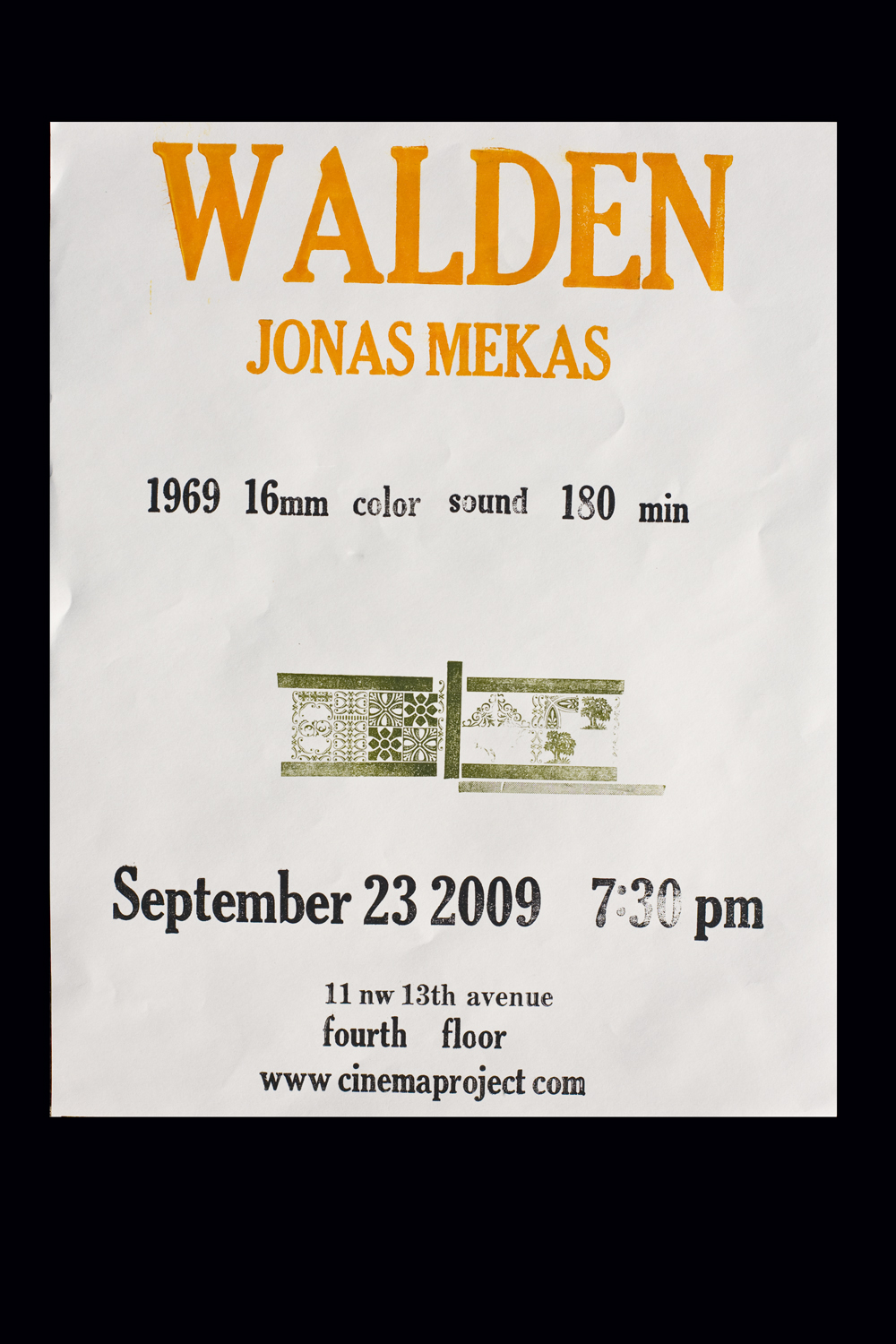
My own first encounter with Cinema Project dates back to 2008 when they were able to secure the scarcely seen short films by Apichatpong Weerasethakul for a screening at the Whitsell Auditorium.  Other notable past presentations have included Jonas Mekas' mind-blowingly epic cinematic diary Walden, the most recent work by experimental puppet theater and film director Janie Geiser and far too many other rare gems to recount here.


An excerpt from Walden (1969) by Jonas Mekas:


An excerpt from Worldly Desires (2005) by Apichatpong Weerasethakul:


Even a quick perusal of this season's schedule reveals that Cinema Project's programming is unlike anything else on offer in Portland.  We're extremely fortunate to have these folks kicking around our town, especially when one considers how few organizations like this are available on the national scene.

Here's a link to their Kickstarter page, complete with a budgetary breakdown of what operations the funds will cover.  And as of this writing, they've got about 8 days left to raise just under $2K.  As with most Kickstarter campaigns, there are "prizes" associated with the various levels of support.  Lend them a hand, if you can.  And don't forget to check out one of their upcoming screenings...the next one's on October 11th at 6p.m.


Remember to find and "like" us on our Facebook page.
Subscribe to the blog's feed here.

Thursday, January 27, 2011

Grand Detour and Reverse Town


This past Tuesday night (1/25), PDX' own experimental film and video exhibition group Grand Detour presented a series of shorts produced by the filmmakers of Reverse Town at the Hollywood Theater.

Reverse Town is a six-member collective of film geeks who all met while gathering skills at the NW Film Center School of Film.

The Grand Detour program consisted of eight short films, including:
Positive dir. by Liz Lewis (trailer)
Bobby Beats by Liz Lewis (full film link)
Death Walker dir. by Daniel Klockenkemper (full film link)
Rougarou dir. by Michael Roberson (full film link)
and additional work by Brian Lancaster, Mario Garza and Ian Geronimo.
submit to reddit